Univ.-Prof. Dr. Egon Wanke

Universitätsprofessor der Heinrich-Heine-Universität Düsseldorf, im Ruhestand
Algorithmen und Datenstrukturen / Algorithmik
Institut für Informatik
Heinrich-Heine-Universität Düsseldorf
Universitätsstraße 1
D-40225 Düsseldorf
Deutschland / Germany
E-Mail: Egon.Wanke@hhu.de
Die Arbeitsgruppe "Algorithmik" beschäftigt sich mit dem Entwurf und der Analyse von Algorithmen und Datenstrukturen, mit dem übergeordneten Ziel, das Arbeiten mit immer größeren Datenmengen effizienter zu gestalten.
Unsere Forschung umfasst einerseits die grundlegenden Fragen der Theoretischen Informatik, die aus diesem Ziel folgen und mittels mathematischer Beweise beantwortet werden sollen; etwa die Frage nach der asymptotischen Zeit- und Platzkomplexität der algorithmischen Fragestellung, und andererseits die Gestaltung und Umsetzung von Algorithmen und Datenstrukturen, um theoretische Ergebnisse für praktische Anwendungen zugänglich und gewinnbringend nutzbar zu machen.
Unsere Forschungsergebnisse finden unter anderem Anwendungen beim Entwurf und der Analyse von Ad-hoc- uns Sensornetzwerken, bei der Analyse von Kaubewegungen in der Zahnmedizin, in CAD-Systemen, in der Versandindustrie sowie bei der Konstruktion von meschanischen Schließsystemen.

 Varianten der Metrischen Dimension spezieller Graphklassen (2024)

Die Metrische Dimension spezieller Graphklassen (2020)

Analyse und experimentelle Auswertung verschiedener Routing-Protokolle mit virtuellen Koordinaten auf Sensornetzen (2019)
Graph Connectivity with Respect to Wireless Ad-Hoc Sensor Networks (2016)

Algorithmische Analyse makroskopischer Verbindungsstrukturen im Primatengehirn (2008)
Otto (GmbH & Co KG)
Experimentation Owner
Effziente Algorithmen für baumstrukturierte Graphklassen (2003)
Heinrich-Heine-Universität Düsseldorf
Institut für Informatik
 +49 211 8113710
 www.hhu.de
 Frank Gurski
Bewegungsminimierung in der Förderband-Flow-Shop-Verarbeitung (2001)
Algorithmen zur Steuerung industrieller Abstapelanlagen, Analyse und Optimierung (1999)
Hochschule Niederrhein
FB Elektrotechnik und Informatik
+49 2151 8224633
www.hs-niederrhein.de
Jochen Rethmann
Forschungsaktivitäten
Theoretische Themenbereiche
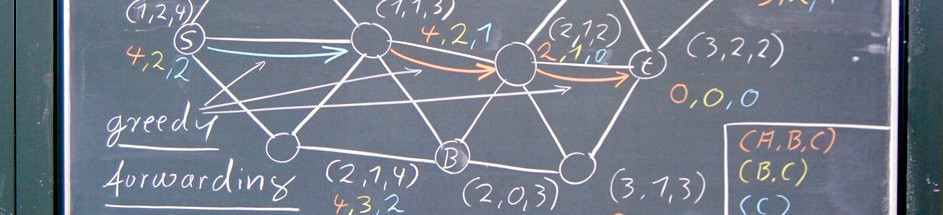
- Algorithmen für Ad-hoc- und Sensornetzwerke
- Algorithmen für spezielle Graphklassen
- Hierarchische Graphen
- Gitterstrukturierte Graphen
- Graphersetzungssysteme
Angewandte Themenbereiche
- Positionsbestimmung von elektromagnetischen Entladungen in der Atmosphäre
- Kauanalysen mit Hilfe medizinischer Sensordaten
- Algorithmische Analyse makroskopischer Verbindungsstrukturen im Primatengehirn
- Bewegungsminimierung für Flow-Shop-Förderbandsysteme und Abstapelprobleme
- Rechnergestützter Entwurf von mechanisch kodierten Schließsystemen
Aktuelle Projekte: Algorithmische Analyse von Kaubewegungen
 Assessment of chewing efficiency
Kaubewegungen sind rhythmische „Auf- und Ab-Bewegungen“ in Kombination mit Seitwärtsbewegungen des Unterkiefers, die vom Abbeißen oder Einbringen der Nahrung in die Mundhöhle eingeleitet werden. Dieses Projekt beschäftigt sich mit der allgorithmischen Effizienzanalyse von Kaubewegungen. Es ist eine Kooperation zwischen dem UKD und der HHU.

Öffnungsbewegungen an virtuellen Messpunkten / Opening movements at virtual measuring points
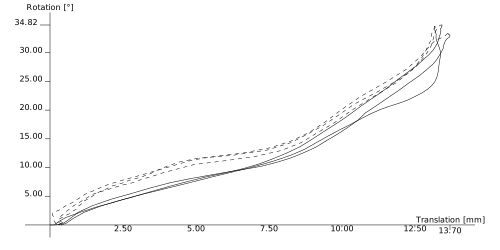
Rotation / Translation Diagramm / Rotation / translation diagram
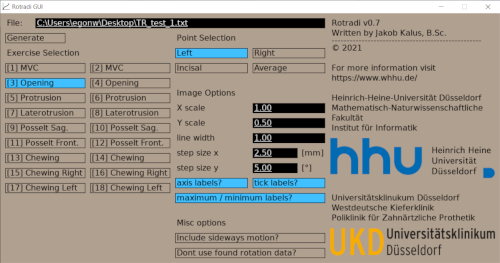
"Rotradi", ein Programm zur Erstellung von Rotation/Translation Diagrammen / "Rotradi", a program for creating rotation / translation diagrams
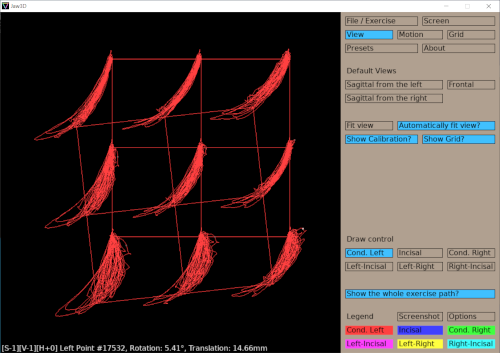
"Jaw", ein Programm zur Vermessung von Kaubewegungen / "Jaw", a program for measuring chewing movements
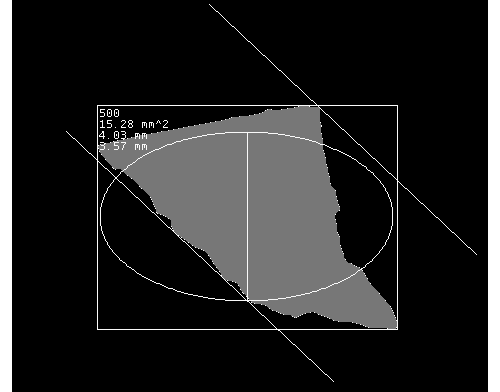
Zerkautes Kaugut / Chewed chew
Partikelvermessung / Particle measurement
Zeichenerklärung
B = Bachelor Studiengang Informatik
M = Master Studiengang Informatik
Vx = Vorlesungen, x Semesterwochenstunden
Üx = Übungen, x Semesterwochenstunden
Sx = Seminar, x Semesterwochenstunden
LPx = x Leistungspunkte
SS 2026
Algorithmen und Datenstrukturen II (M, V4, Ü2, LP10)
WS 2025
Graphenalgorithmen II (M, V4, Ü2, LP10)
SS 2025
Algorithmen und Datenstrukturen II (M, V4, Ü2, LP10)
Bchelor-Seminar: Algorithmen kurzgesagt (B, S2, Ü2, LP5)
WS 2024
Graphenalgorithmen II (M, V4, Ü2, LP10)
SS 2024
Algorithmen und Datenstrukturen II (M, V4, Ü2, LP10)
Bchelor-Seminar: Algorithmen kurzgesagt (B, S2, Ü2, LP5)
WS 2023
Algorithmen für Ad-hoc- und Sensornetzwerke (M, V4, Ü2, LP10)
Master-Seminar über Algorithmen für graphentheoretische Konzepte in der Informatik (M, S2, Ü2, LP5)
SS 2023
Algorithmen und Datenstrukturen II (M, V4, Ü2, LP10)
WS 2022
Graphenalgorithmen II (M, V4, Ü2, LP10)
Algorithmische Komplexitätstheorie (B, V2, Ü2, LP5)
SS 2022
Algorithmen für Ad-hoc- und Sensornetzwerke (M, V4, Ü2, LP10)
Master-Seminar über Algorithmen für graphentheoretische Konzepte in der Informatik (M, S2, Ü2, LP5)
WS 2021
Graphenalgorithmen I (B, V2, Ü2, LP5)
Graphenalgorithmen II (M, V4, Ü2, LP10)
SS 2021
Algorithmische Geometrie (B, V2, Ü2, LP5)
Algorithmische Komplexitätstheorie (B, V2, Ü2, LP5)
WS 2020
Algorithmen und Datenstrukturen I (B, V4, Ü2, LP10)
SS 2020
Algorithmen für Ad-hoc- und Sensornetzwerke (M, V4, Ü2, LP10)
WS 2019
Graphenalgorithmen II (M, V4, Ü2, LP10)
Master-Seminar über Algorithmen für graphentheoretische Konzepte in der Informatik (M, S2, Ü2, LP5)
SS 2019
Algorithmische Geometrie (B, V2, Ü2, LP5)
Graphenalgorithmen I (B, V2, Ü2, LP5)
WS 2018
Algorithmen für Ad-hoc- und Sensornetzwerke (M, V4, Ü2, LP10)
SS 2018
Graphenalgorithmen II (M, V4, Ü2, LP10)
Algorithmische Komplexitätstheorie (B, V2, Ü2, LP5)
WS 2017
Algorithmen und Datenstrukturen I (B, V4, Ü2, LP10)
Algorithmische Geometrie (B, V2, Ü2, LP5)
SS 2017
Algorithmen für Ad-hoc- und Sensornetzwerke (M, V4, Ü2, LP10)
Graphenalgorithmen I (B, V2, Ü2, LP5)
WS 2016
Graphenalgorithmen II (M, V4, Ü2, LP10)
Algorithmische Komplexitätstheorie (B, V2, Ü2, LP5)
SS 2016
Algorithmen für Ad-hoc- und Sensornetzwerke (M, V4, Ü2, LP10)
Algorithmische Geometrie (B, V2, Ü2, LP5)
WS 2015
Algorithmen und Datenstrukturen I (B, V4, Ü2, LP10)
SS 2015
Graphenalgorithmen II (M, V4, Ü2, LP10)
Graphenalgorithmen I (B, V2, Ü2, LP5)
WS 2014
Forschungssemester
SS 2014
Algorithmen für Ad-hoc- und Sensornetzwerke (M, V4, Ü2, LP10)
Algorithmische Komplexitätstheorie (B, V2, Ü2, LP5)
WS 2013
Algorithmen und Datenstrukturen I (B, V4, Ü2, LP10)
Graphenalgorithmen I (B, V2, Ü2, LP5)
SS 2013
Algorithmen für Ad-hoc- und Sensornetzwerke (M, V4, Ü2, LP10)
Algorithmische Komplexitätstheorie (B, V2, Ü2, LP5)
WS 2012
Spezielle Graphklassen (M, V4, Ü2, LP10) Graphenalgorithmen I (B, V2, Ü2, LP5)
SS 2012
Algorithmen für Ad-hoc- und Sensornetzwerke (M, V4, Ü2, LP10)
WS 2011
Spezielle Graphklassen (M, V4, Ü2, LP10)
SS 2011
Algorithmen für Ad-hoc- und Sensornetzwerke (M, V4, Ü2, LP10)
WS 2010
Algorithmen und Datenstrukturen I (B, V4, Ü2, LP10)
Graphenalgorithmen I (B, V2, Ü2, LP5)
SS 2010
Algorithmen für Ad-hoc- und Sensornetzwerke (M, V4, Ü2, LP10)
WS 2009
Spezielle Graphklassen (M, V4, Ü2, LP10)
Graphenalgorithmen I (B, V2, Ü2, LP5)
SS 2009
Algorithmen für Ad-hoc- und Sensornetzwerke (M, V4, Ü2, LP10)
Algorithmische Komplexitätstheorie (B, V2, Ü2, LP5)
WS 2008
Algorithmen und Datenstrukturen I (B, V4, Ü2, LP10)
Graphenalgorithmen I (B, V2, Ü2, LP5)
SS 2008
Forschungssemester
WS 2007
Algorithmen und Datenstrukturen I (B, V4, Ü2, LP10)
SS 2007
Algorithmentheorie (B, V4, S2, Ü2, LP5)
WS 2006
Algorithmen und Datenstrukturen I (B, V4, Ü2, LP10)
Algorithmische Geometrie (B, V2, U2)
SS 2006
Graphenalgorithmen I (B, V2, Ü2, LP5)
Algorithmische Komplexitätstheorie (B, V2, Ü2, LP5)
WS 2005
Algorithmen und Datenstrukturen I (B, V4, Ü2, LP10)
Algorithmen (B, S2, Ü2, LP5)
SS 2005
NP-Vollständigkeit - Theorie und Anwendungen (B, V2, Ü2, LP5)
Graphenalgorithmen I (B, V2, Ü2, LP5)
WS 2004
Algorithmen und Datenstrukturen I (B, V4, Ü2, LP10)
Graphenalgorithmen I (B, V2, Ü2, LP5)
2026
2026/07, Bachelorarbeit, Trang Quang, Minimum Range Queries
2026/07, Bachelorarbeit, Shubham Bista, Blitzvorhersagen
2026/07, Masterarbeit, Nour Akkash, Algorithmische Aspekte temporaler Graphen
2026/05, Bachelorarbeit, Bjarne Sören Ludolph, Algorithmen für 3-uniforme Hypercographen
2026/04, Bachelorarbeit, Atefeh Sadat Kermanian, Effizienzvergleich von Suffix-Array Berechnungen
2026/03, Masterarbeit, Sabit Canelina Deniz, Pseudopolynomielle Algorithmen zur Optimierung von Lebensmittelmischungen
2026/03, Bachelorarbeit, Sevim Melisa Arslan, Minimale universelle Kontrollsequenzen zum Entkommen aus gerichteten Graphen
2025
2025/11, Masterarbeit, Selina Koch, Minimale Spanngraphen von Hypergraphen mit beschränkter Cliquenweite
2025/11, Masterarbeit, Iven Andreas Buchholz, Analysen zur Lebensdauermaximierung drahtloser Sensornetzwerke
2025/09, Bachelorarbeit, Dennis Tom Kasprzyk, Experimentelle Analyse von Algorithmen zur Erkennung temporärer Heavy-Hitter
2025/07, Bachelorarbeit, Nikita Rodionov, Interaktive Visualisierung von Halbebenenabfragen mittels des Ham-Sandwich-Theorems
2025/07, Masterarbeit, Benedikt Georg Hein, Minimale geodätische Mengen in gerichteten kreisfreien Graphen
2025/06, Bachelorarbeit, Taotzkoafi Suppiyar, Tree 3-spanners of chordal bipartite graphs
2025/02, Bachelorarbeit, Hongjia Wang, Finding the maximum number of vertices on shortest paths with the A* Algorithm
2024
2024/11, Bachelorarbeit, Ruiheng Liang, A Study of Preflow Push Algorithms for the Maximum-Flow Problem
2024/10, Bachelorarbeit, Thomas Bartkowiak, Kreuzungsminimierung zirkulärer Graphen
2024/07, Bachelorarbeit, Yufan Chen, Entwicklungen und Vergleiche von Directed Minimum Spanning Tree Algorithmen
2024/06, Bachelorarbeit, Ngoc Phong Nguyen, Voronoi-Diagramme für entfernteste Punkte
2024/05, Bachelorarbeit, Jan Philip Orlob, Geometrische Dualität mit Anwendungen in der Computergraphik
2024/04, Bachelorarbeit, Sebastian Marc Langen, Kürzeste Wege in der Ebene mit polygonalen Hindernissen
2024/03, Bachelorarbeit, Florian Köhler, Geographic Routing und Beacon Vector Routing im Vergleich angewendet auf Sensornetzwerke
2024/02, Masterarbeit, Julian Kremer, K-Cographs, Properties and Algorithms
2024/02, Bachelorarbeit, Tanjia He, Exploring the Width of Directed Acyclic Graphs
2024/01, Bachelorarbeit, Maren Brand, Algorithmen für hierarchisch definierte Punktmengen
2023
2023/12, Bachelorarbeit, Jessica Thiele, Implementierungsdetails zur Dynamischen Konnektivität in Graphen
2023/09, Bachelorarbeit, Yixue Wang, Algorithmische Analysen distanzerhaltender Graphen
2023/09, Bachelorarbeit, Sabit Canelina Deniz, Subset Sum Probleme mit Graphbeschränkungen
2023/08, Bachelorarbeit, Martin Breuer, Die metrische Dimension gerichteter Graphen
2023/07, Bachelorarbeit, Ronny Bümmer, Graph-Layout-Probleme für ungerichtete und gerichtete Graphen
2023/07, Bachelorarbeit, K. A., Berechnung der konvexen Hülle im zwei- und dreidimensionalen Euklidischen Raum
2023/06, Bachelorarbeit, Matthias Hartmann, Punktlokalisierung in der Ebene mittels Trapezzerlegung
2023/04, Bachelorarbeit, Julia Marlene Wallnig, Graphen mit beschränkter Wegweite und das Steinerbaumproblem
2023/03, Bachelorarbeit, Benedikt Georg Hein, Das induzierte disjunkte Wege Problem
2023/03, Bachelorarbeit, Yang Cao, Balancieren von Minimalen Spannbäumen und Kürzeste-Wege Bäumen
2023/02, Masterarbeit, Jakob Kalus, On directed distance hereditary graphs and steiner path covers
2022
2022/10, Bachelorarbeit, Simon Lukas Kampa, Low memory Algorithmen - Analyse der Laufzeit und des Speicherplatzes von Algorithmen mit geringem Speicherbedarf
2022/08, Bachelorarbeit, Vincent Henrik Brunner, Eine empirische Überprüfung der Konfidenzintervalle von Datenstromalgorithmen am Beispiel von Count-Min Sketches
2022/05, Bachelorarbeit, Florian Fischer, Maintaining dynamic convex hulls using an efficient data structure
2021
2021/11, Bachelorarbeit, Alexander Sebastian Stach, Über die gerichtete metrische Dimension
2021/04, Masterarbeit, Ngoc Thach Nguyen, Ein parametrisierter Algorithmus für die Berechnung der metrischen Dimension
2021/01: Masterarbeit, Daniela Prigge, Datensammlung in Netzwerken mit Hilfe mehrfacher Fremdkodierungen
2020
2020/11, Bachelorarbeit, Jabob Kalus, On Kelly-width
2020/10, Bachelorarbeit, Berkant Kaan Özmen, Wegüberdeckungsprobleme auf Intervallgraphen
2020/10, Bachelorarbeit, Marcel Wagner, Über die starke metrische Dimension von verknüpften Graphen
2020/10, Masterarbeit, Yannick Schmitz, Über die Komplexität einiger Varianten der Metrischen Dimension
2020/09, Masterarbeit, Sebastian Georg, Datensammlung auf Bäumen mit Hilfe von Selbstkodierung
2020/06, Masterarbeit, Vadim Breininger, Leistungsanalyse des Link Reversal Algorithmus
2020/06, Bachelorarbeit, Michael Borisov, Algorithmen zur Berechnung flächengrößter Rechtecke in Polygonen
2020/04, Bachelorarbeit, Henrik Björn Grosche, Kürzeste Wege in Polygonen
2020/04, Bachelorarbeit, Stefan Söhl, Experimentelle Laufzeitanalyse von Algorithmen für die Berechnung kleinster umschließender Kreise
2020/04, Bachelorarbeit, Jan-Eike Brocker, Ein randomisierter Algorithmus zur Triangulation einfacher Polygone
2020/01, Masterarbeit, Nicholas Schuster, Reconstructing Scenes of Known Objects from 3D Scans
2019
2019/09, Masterarbeit, Julian Burghoff, Die starke metrische Dimension spezieller Graphklassen
2019/06, Masterarbeit, Thomas Germer, Alpha Matting Revisited
2019/04, Masterarbeit, Dominique Komander, Characterization and Algorithmic Use of Directed Cographs
2019/01, Bachelorarbeit, Yannick Schmitz, Fehlertolerante Metrische Dimension spezieller Graphklassen
2018
2018/09, Bacheorarbeit, Daniela Prigge, Geometrische Dualität
2018/08, Bachelorarbeit, Luisa Schumacher, Orientierte Färbung von Graphen
2018/08, bachelorarbeit, Ngoc Thach Nguyen, Grundlagen der parametrisierten Komplexitätstheorie
2018/05, Bachelorarbeit, Jan-Hendrick Oepen, Algorithmen für hierarchisch definierte Punktmengen
2018/05, Masterarbeit, Kathleen Pietruska, Algorithmen zur Bestimmung der gewichteten metrischen Dimension spezieller Graphklassen
2018/03, Bachelorarbeit, Eric Upschulte, Machine Learning Methoden für die Partikelanalyse
2017
2017/111, Masterarbeit, Carolin Rehs, Efficient Algorithms for Knapsack Problems using Threshold Graphs
2017/09, Bachelorarbeit, Sebastian Georg, Finden kürzester Wege über triangulierte Oberflächen - Eine Implementierung des „Discrete Geodesic Problem
2017/04, Bachelorarbeit, Alison Hinz, Vorhersagen der Zellentiefe in einem Gewebeschnitt anhand von Formmerkmalen
2017/03, Masterarbeit, Hoy-Chung Manuel Noguchi, Positionsbestimmung mit Hilfe von Signalankunftszeiten
2017/03, Bachelorarbeit, Deniz Ates, Algorithmen für Graphen mit beschränkter Baumweite
2016
2016/11, Bachelorarbeit, Thomas Germer, Rendering of Vector Graphics on the GPU
2016/10, Bachelorarbeit, Matthias Kollenbroich, Wegfindung auf dynamischen dreidimensionalen Oberflächen
2016/08, Bachelorarbeit, Kathleen Pietruska, Ungerichtete kürzeste Wege mit positiven ganzzahligen Gewichten in linearer Zeit
2016/08, Masterarbeit, Thomas Kampermann, Datensammlung durch Selbstkodierung indrahtlosen Sensornetzwerken
2015
2015/12, Masterarbeit, Duygu Vietz, Die Metrische Dimension spezieller Graphklassen
2015/07, Bachelorarbeit, Vadim Breininger, Rand- und Topologieerkennung in großen Netzwerken
2015/07, Bachelorarbeit, Felix Scholz, Zielverfolgung mit verteilten Sensoren
2015/06, Bachelorarbeit, Patrick Cassel, Approximationsalgorithmen für das Steinerbaumproblem
2013
2013/10, Bachelorarbeit, Helinmandelo Canisiyus, Energieminimale Datensammlung in Sensornetzwerken mit Hilfe von Netzwerkkodierungen
2013/10, Bachelorarbeit, Peter Klepak, Synchronisation in Sensornetzwerken
2012
2012/12, Masterarbeit, Alina Eltermann, Metrische Dimension spezieller Graphklassen
2012/08, Masterarbeit, Stefan Hoffmann, Auswahlprobleme für Ad-hoc- und Sensornetzwerke
2011
2011/11, Masterarbeit, Marcel Sengespeik, Methoden zur Charakterisierung von Kaubewegungen
2011/05, Bachelorarbeit, Joachim Eßer, Lösungsansätze für das Sender-Empfänger-Zuordnungsproblem
2011/031, Masterarbeit, Patrick Poullie, Effiziente Methoden fu ̈r optimales Routing in speziellen Netzwerken
2011/03, Bachelorarbeit, Ould El Aghob, MohamedHorma, Exponentielle Algorithmen für das CSP Problem
2011/01, Masterarbeit, Mateusz Pokornowski, Methoden zur Lokalisierung in Sensornetzwerken
2010
2010/05, Bachelorarbeit, Roland Wimmer, Software zur Visualisierunh von netzwerk-Fluss-Algorithmen
2010/03, Bachelorarbeit, Stefan Hoffmann, Ausgewählte Eigenschaften von Unit Disk Graphen
2009
2009/12, Bachelorarbeit, Patrick Gwydion Poulline, Der Algorithmus von Hopcroft und Tarjan zur effizienten Berechnung der dreifachen Zusammenhangskomponenten
2009/09, Bachelorarbeit, Stefhane Onder de Linden, Characterisierung der Nachbarschaftsweite von Bäumen
2009/08, Bachelorarbeit, Dominik Hurtienne, Die Branch-Weite im Vergleich zur Baumweite
2009/02, Bachelorarbeit, Mateusz Pokornowski, Über die Struktur komplexer Netzwerke
2008
2008/07, Masterarbeit, Daniela Wonsak, Graphklassen definiert mit Hilfe von one-vertex-extensions
2007
2007/05, Diplomarbeit, Daniel Gaußmann, Algorithmen zur Mustersuche in Zeichenfolgen
2008/01, Bachelorarbeit, Matthias Zoche, Parallele Komplexitätsklassen
2007/08, Bachelorarbeit, Said Tehrani, Finden optimaler Hierarchien in Netzwerken mit linearen Gleichungssystemen
2007/06, Bachelorarbeit, Armelle Flaure Djeutsap Nguimanang, Modulare Dekomposition
2007/06, Masterarbeit, Henning Treu, Kauzyklenerkennung Medizinischer Sensordaten
2007/03, Masterarbeit, Pavel Tenenbaum, Synchronisationsalgorithmen für Zeitreihen elektrostatischer Entladungen in der Atmosphäre
2006
2006/11, Bachelorarbeit, Andrei Vitiazev, An Algorithm for Solving Special Boolean Equation Systems
2006/04, Diplomarbeit, Marco Abraham, Effiziente Berechnungen für Zentralitätsmaße in Netzwerken
2005
2005/09, Diplomarbeit, Jan Bedenbender, Graphpartitionierung in zusammenhängenden Teilgraphen
2004
2004/01, Diplomarbeit, Stefan Gluth, Implementierungen von NLC-Erkennungsalgorithmen
2001
2001/10, Diplomarbeit, Antje Hinz, Größte gemeinsame Teilgraphen für spezielle Graphklassen
2000
2000/04, Diplomarbeit, Udo Müller, Mathematissche Grundlagen für den Entwurf von mechanischen Schließanlagen
1999
1999/07, Diplomarbeit, Oliver Stoll, Ein einfacherAlgorithmus zur Minimierung der Wegkosten in der Flow-hop-Verarbeitung auf Förderbändern
1999/03, Diplomarbeit, Marco Weertz, Kryptographische Verfahren und protokolle für sichere elektronische Zahlsysteme im Internet
1998
1998/10, Diplomarbeit, Monika Trapitz, Erkennung von Graphen mit linearen Graphautomaten
1998/09, Diplomarbeit, Frank Gurski, Algorithmische Charakterisierungen Spezieller Graphklassen
2026 Katharina Lisa-Maria Schmidt, Partikelgrößenbestimmung zur Erfassung der Kauleistung mittels optischem Scanverfahren - eine klinische Studie
2024 Yannick Schmitz, Varianten der Metrischen Dimension spezieller Graphklassen
2022 Carolin Rehs, Comparing and Computing Parameters for Directed Graphs (Betreuer/Erstgutachter PD Dr. Frank Gurski)
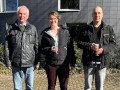
2022 Dominique Komander, Characterizations and Algorithms for Special Digraph Classes (Betreuer/Erstgutachter PD Dr. Frank Gurski)
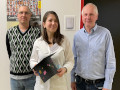
2020 Duygu Vietz, Die Metrische Dimension spezieller Graphklassen

2019 Sebastian Ginzel, Enabling Versatile and Comprehensive Analysis of Genomic Variant Data (zusammen mit Prof. Dr. Ralf Thiele und Prof. Dr. Arndt Borkhardt)
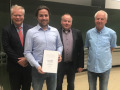
2019 Daniel Gaußmann, Analyse und experimentelle Auswertung verschiedener Routing-Protokolle mit virtuellen Koordinaten auf Sensornetzen
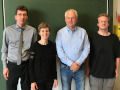
2016 Stefan Hoffmann, Graph Connectivity with Respect to Wireless Ad-Hoc Sensor Networks
2010 Alexandra Kravchenko, Reproduzierbarkeit von Kaufunktionsdaten in einer klinischer Studie (Prof. Dr. Alfons Hugger und Dr. Thomas Beikler)
2010 Gleb Bezgin, Linking Logical and Coordinate-based Resources for Interoperability of Primate Brain Mapping and Connectivity Data (zusammen mit Prof. Dr. Rolf Kötter)
2010 Andrew Reid, Connectivity and Morphology of the Primate Brain (zusammen mit Prof. Dr. Rolf Kötter)
2008 Antje Krumnack, Algorithmische Analyse makroskopischer Verbindungsstrukturen im Primatengehirn
2003 Frank Gurski, Effziente Algorithmen für baumstrukturierte Graphklassen
2001 Wolfgang Espelage, Bewegungsminimierung in der Förderband-Flow-Shop-Verarbeitung
1999 Jochen Rethmann, Algorithmen zur Steuerung industrieller Abstapelanlagen, Analyse und Optimierung
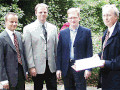
DBLP - Egon Wanke
Google Scholar - Egon Wanke
2026
F. Gurski, J. Rethmann and E. Wanke. Recursively Constructed Uniform Hypergraphs. Algorithms 2026, 19(7), 575. https://doi.org/10.3390/a19070575 (registering DOI), 2026
B.G. Hein and E. Wanke. Geodetic sets for directed acyclic planar geodetic graphs. CoRR abs/2607.07107, 2026.
2023
 M. Kamogawa, T. Suzuki, H. Fujiwara, T. Narita, E. Wanke, K. Murata, T. Nagao, K. Tetsuya, J. Izutsu, A. Matsuki, N. Tang and Y. Minamoto.
Characteristics of the Blitzortung.org Lightning Location Catalog in Japan.
Atmosphere 2023, 14, 1507. https://doi.org/10.3390/atmos14101507, 2023
Y. Schmitz, D. Vietz and E. Wanke. A note on the complexity of k-metric dimension. Applied Mathematics and Computation, Volume 457, 128204, 2023.
Y. Schmitz and E. Wanke. The directed metric dimension of directed co-graphs. CoRR abs/2306.08594, 2023.
2022
M. Wagner, Y. Schmitz and E. Wanke. On the strong metric dimension of composed graphs. CoRR abs/2212.04166, 2022.
F. Gurski, D. Komander, C. Rehs, J. Rethmann and E. Wanke, Computing Directed Steiner Path Covers. Journal of Combinatorial Optimization, 43:402-431, 2022.
2021
Y. Schmitz, D. Vietz and E. Wanke. A note on the complexity of k-metric dimension. CoRR abs/2101.12018, 2021.
Y. Schmitz and E. Wanke. On the strong metric dimension of directed co-graphs. CoRR abs/2111.13054, 2021.
2020
F. Gurski, S. Hoffmann, D. Komander, C. Rehs, J. Rethmann and E. Wanke. Computing Directed Steiner Path Covers for Directed Co-Graphs (Extended Abstract). In Proceedings of the 46th International Conference on Current Trends in Theory and Practice of Computer Science (SOFSEM 2020), LNCS, 12011, 556-565. Springer-Verlag, 2020.
F. Gurski, D. Komander, C. Rehs, J. Rethmann and E. Wanke Computing Directed Steiner Path Covers. CoRR abs/2012.12232, 2020.
2019
F. Gurski, S. Hoffmann, D. Komander, C. Rehs, J. Rethmann and E. Wanke. Exact Solutions for the Steiner Path Problem on Special Graph Classes (Abstract). International Conference on Operations Research (OR), 2019.
D. Vietz and E. Wanke. The Fault-Tolerant Metric Dimension of Cographs. In proceedings of the International Symposium on Fundamentals of Computation Theory (FCT 2019), LNCS, 11651:350-364, Springer Verlag, 2019.
D. Vietz, S. Hoffmann and E. Wanke. Computing the Metric Dimension by Decomposing Graphs into Extended Biconnected Components. (Extended Abstract) In proceedings of the 13th International Conference, Algorithms and Computation (WALCOM 2019), LNCS, 11355:175-187, Springer Verlag, 2019.
F. Gurski, C. Rehs, J. Rethmann and E. Wanke. Controlling Distribution Conveyors and Multi-Line Palletizers: Theoretical Foundations and Online Algorithms. OR Spectrum, 41(2), 581-611, 2019.
2018
T. Narita, E. Wanke, M. Sato, T. Sakanoi, A. Kumada, M. Kamogawa, I. Hirohiko, S. Harada, T. Kameda, F. Tsuchiya, Eiji Kaneko. A study of lightning location system (Blitz) based on VLF sferics. In proceedings of the 34th International Conference on Lightning Protection (ICLP 2018), DOI: 10.1109/ICLP.2018.8503311, IEEE, 1-7, 2018.
S. Hoffmann, T. Kampermann and E. Wanke. Minimizing the Number of Max-Power Users in Ad-Hoc Wireless Networks with Minimum Node Degree Requirements Information Processing Letters, 136:25-29, 2018.
F. Gurski, J. Rethmann and E. Wanke. On-line Algorithms for Controlling Palletizers. In Proceedings of the International Conference on Operations Research (OR 2016), 119-125, 2018.
2017
F. Gurski, J. Rethmann and E. Wanke. On-line Algorithms for Controlling Distribution Conveyors and Multi-line Palletizers (Abstract). International Conference on Operations Research (OR), 2017.
F. Gurski, J. Rethmann and E. Wanke. An Experimental Study of Algorithms for Controlling Palletizers (Abstract). In proceedings of the International Conference on Operations Research (OR 2016), 27-33, 2017.
S. Hoffmann and E. Wanke. The Neighborhood Broadcast Problem in Wireless Ad Hoc Sensor Networks. International Journal on Applications of Graph Theory in Wireless Ad hoc Networks and Sensor Networks (GRAPH-HOC) Vol.9, No.1, March 2017.
2016
S. Hoffmann and E. Wanke. Minimum Power Range Assignment for Symmetric Connectivity in Sensor Networks with two Power Levels. arXiv: 1605.01752, 2016.
S. Hoffmann, A. Elterman and E. Wanke. A linear time algorithm for metric dimension of cactus block graphs. Theoretical Computer Science, 640:42-62, 2016.
S. Hoffmann and E. Wanke. Generic Route Repair: Augmenting Wireless Ad Hoc Sensor networks for Local Connectivity. In proceedings of the 15th ACM/IEEE International Conference on Information Processing in Sensor Networks (IPSN), 2016.
F. Gurski, E. Wanke and E. Yilmaz. Directed NLC-width. Theoretical Computer Science, 616:1-17,2016.
F. Gurski, J. Rethmann and E. Wanke. On the Complexity of the FIFO Stack-Up Problem. Mathematical Methods of Operations Research (MMOR), 83(1):33-52, 2016.
F. Gurski, J. Rethmann and E. Wanke. Algorithms for Controlling Palletizers. In Proceedings of the International Conference on Operations Research (OR 2014), Selected Papers of the International Annual Conference of the German Operations Research Society (GOR), 197-203, Springer Verlag, 2016.
2015
F. Gurski, J. Rethmann and E. Wanke. Integer Programming Models and Parameterized Algorithms for Controlling Palletizers. Technical Report 1509.07278, ACM Computing Research Repository (CoRR), 27 pages, 2015.
F. Gurski, J. Rethmann and E. Wanke. Directed Pathwidth and Palletizers. In proceedings of the International Conference on Combinatorial Optimization and Applications (COCOA), LNCS, 9486:31-44, Springer Verlag, 2015.
F. Gurski, J. Rethmann and E. Wanke. A Practical Approach for the FIFO Stack-Up Problem. In Proceedings of the International Conference on Modelling, Computation and Optimization in Information Systems and Management Sciences (MCO 2015), volume 360 of Advances in Intelligent Systems and Computing, pages 141-152. Springer Verlag, 2015.
2014
F. Gurski, J. Rethmann and E. Wanke. Algorithms for the FIFO Stack-up Problem (Abstract). 20th Conference of the International Federation of Operational Research Societies (IFORS), 2014.
F. Gurski, J. Rethmann and E. Wanke. Moving bins from conveyor belts onto pallets using FIFO queues. In Proceedings of the International Conference on Operations Research (OR 2013), Selected Papers of the International Annual Conference of the German Operations Research Society (GOR), pages 185-191, Springer Verlag, 2014.
A. Kravchenko, A. Weiser, S. Hugger, B. Kordaß, A. Hugger, E. Wanke. Variability and Reliability of Muscle Activity Measurements During Chewing. International Journal of Computerized Dentistry, 17(1):21-33, 2014.
2013
J. Rethmann, F. Gurski and E. Wanke. Complexity of the FIFO Stack-Up Problem. Technical Report 1307.1915, ACM Computing Research Repository (CoRR), 19 pages, 2013.
A. Hugger, S. Weiser, A. Kravchenko, R. Willers and E. Wanke. Characterizing chewing patterns by Soerensen distance method. Society of Oral Physiology: Abstracts of the the 28th Store Kro Club Conference in Amsterdam, The Netherlands, 23th–26th May 2013, Abstracts of Oral Presentations 2013.
2012
D. Gaussmann, S. Hoffmann and E. Wanke. Hierarchical Bipartition Routing for Delivery Guarantee in Sparse Wireless Ad Hoc Sensor Networks With Obstacles. In Proceedings of IWCE '12 at WORLDCOMP'12 - The 2012 World Congress in Computer Science, Computer Engineering and Applied Computing
S. Hoffmann and E. Wanke. Metric Dimension for Gabriel Unit Disk Graphs is NP-Complete. In Proceedings of Algosensors '12, LNCS, 7718:90-92, Springer Verlag, 2012.
2011
A. Hugger, A. Weiser, A. Kravchenko, S. Hugger and E. Wanke. Influence of experimental conditions on kinematic and electromyographic parameters in chewing tasks. Society of Oral Physiology: Abstracts of the the 27th Store Kro Club Conference in Torino, Italy, 26th–29th May 2011, Abstracts of Oral Presentations 2011.
2010
B. van der Zander, E. Wanke, W. Kiess and B. Scheuermann. Complexity and Solution of the Send-Receive Correlation Problem. In Proceedings of the 2010 ACM Symposium on Principles of Distributed Computing, 122-123, ACM 2010.
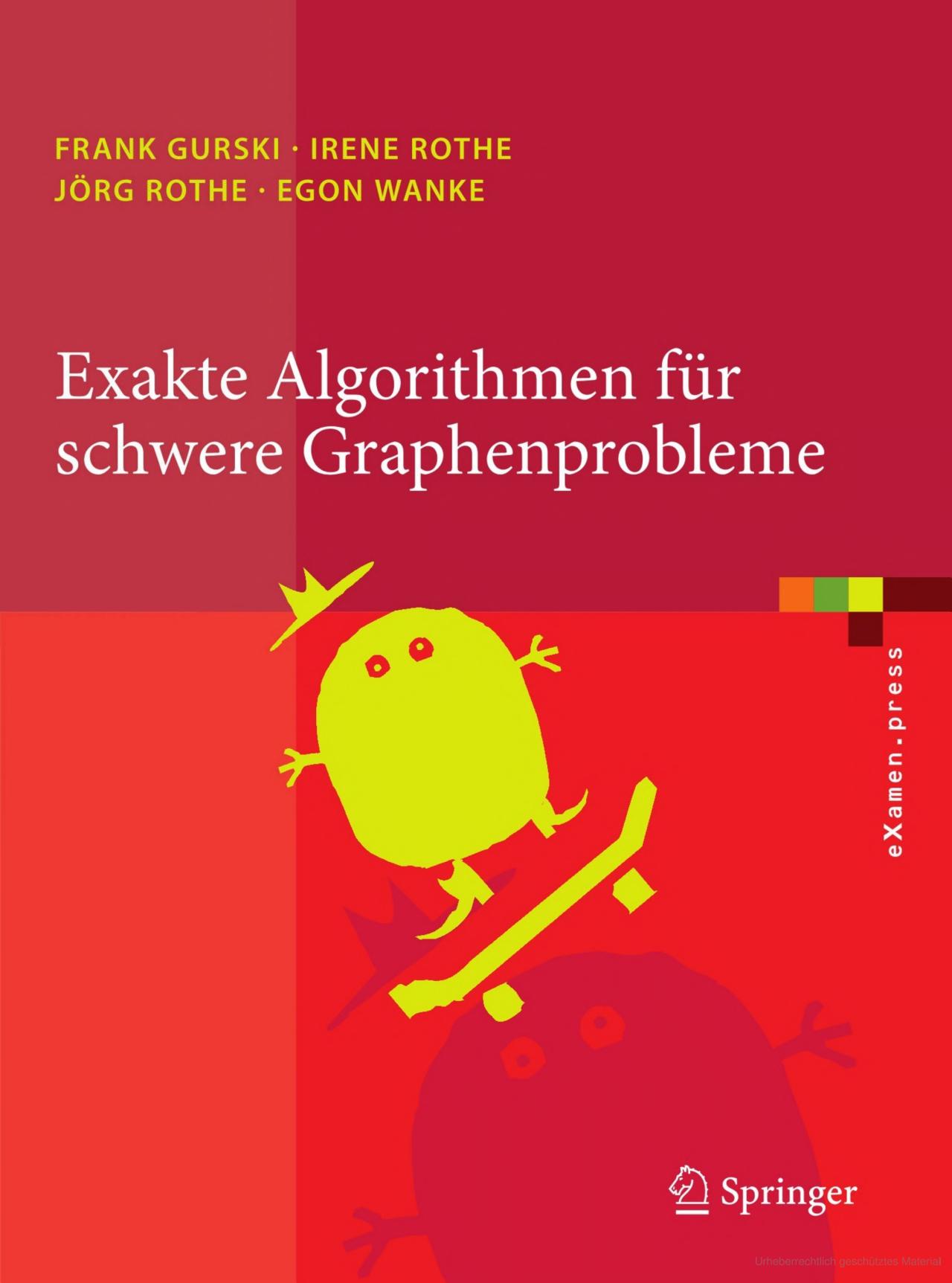 F. Gurski, I. Rothe, J. Rothe, und E. Wanke.
Exakte Algorithmen für schwere Graphenprobleme.
Springer Verlag, Berlin, Taschenbuch, 1. September 2010.
2009
A. Krumnack, A. T. Reid, E. Wanke, G. Bezgin and R. Kötter. Criteria for Optimizing Cortical Hierarchies with Continuous Ranges. Frontiers in Neuroinformatics, 4:7, doi: 10.3389/fninf.2010.00007.
F. Gurski and E. Wanke The NLC-width and clique-width for powers of graphs of bounded tree-width. Discrete Applied Mathematics, 157:583-595, 2009.
F. Gurski and E. Wanke On Module-Composed Graphs. In Proceedings of WG '08, LNCS, 5911:166-177, Springer Verlag, 2009.
A. Hugger, A. Kravchenko, A. Weiser, S. Hugger, H. J. Schindler and E. Wanke. Muscular work ratios within and between masseter muscles during different chewing tasks. Society of Oral Physiology: Abstracts of the the 26th Store Kro Club Conference in Dresden, Germany, 7th–10th May 2009, Abstracts of Oral Presentations 2009.
2008
G. Bezgina, E. Wanke, A. Krumnack and R. Kötter. Deducing logical relationships between spatially registered cortical parcellations under conditions of uncertainty. Neural Networks, 21(8):1132-1145, 2008.
2007
F. Gurski and E. Wanke. Line graphs of bounded clique-width. Discrete Mathematics, 307(22):2734-2753, 2007.
F. Gurski and E. Wanke. A local characterization of bounded clique-width for line graphs. Discrete Mathematics, 307(6):756-759, 2007.
F. Gurski and E. Wanke. The Clique-Width of Tree-Power and Leaf-Power Graphs. In Proceedings of WG '07, LNCS, 4769:76-85, Springer Verlag, 2007.
M. Abraham, R. Kötter, A. Krumnack and E. Wanke. Shapley Ratings in Brain Networks. Frontiers in Neuroinformatics, 1:2, doi: 10.3389/neuro.11.002.2007.
2006
F. Gurski and E. Wanke. Vertex Disjoint Paths on Clique-width bounded Graphs. Theoretical Computer Science, 359(1-3):188-199, 2006.
M. Abraham, R. Kötter, A. Krumnack and E. Wanke. A connectivity rating for vertices in networks. In Proceedings of the 4th IFIP International Conference on Theoretical Computer Science-TCS, 283-298, 2006, Springer Verlag, 2006.
2005
F. Gurski and E. Wanke. On the relation between NLC-width and linear NLC-width. Theoretical Computer Science, 347:76-89, 2005.
R. Kötter and E. Wanke. Mapping brains without coordinates. Philosophical Transactions of The Royal Society: Biological Sciences, 360(1456):751-766, 2005.
W. Espelage and E. Wanke. A linear time approximation algorithm for movement minimization in conveyor flow shop processing. European Journal of Operational Research, 160(2):485-500, 2005.
F. Gurski and E. Wanke. Minimizing NLC-Width is NP-Complete. In Proceedings of WG '05, LNCS, 3787:69-80, Springer Verlag, 2005.
2004
E. Wanke and R. Kötter. Oriented paths in mixed graphs. In Proceedings of ISAAC '04, LNCS, 3341:629-643, Springer Verlag, 2004.
F. Gurski and E. Wanke. Vertex disjoint paths on Clique-width bounded graphs (extended abstract). In Proceedings of LATIN '04, LNCS, 2978:119-128, Springer Verlag, 2004.
2003
W. Espelage, F. Gurski and E. Wanke. Deciding clique-width for graphs of bounded tree-width. Journal of Graph Algorithms and Applications - Special Issue of JGAA on WADS 2001, 7(2):141-180, 2003.
W. Espelage and E. Wanke. Movement minimization for unit distances in conveyor flow shop processing. Mathematical Methods of Operations Research, 57(2):172-206, 2003.
2002
K. Skodinis and E. Wanke. Node replacements in embedding normal form. Journal of Computer and System Sciences, 65(2):351-376, 2002.
2001
J. Rethmann and E. Wanke. Stack-up algorithms for palletizing at delivery industry. European Journal of Operational Research, 128(1):74-97, 2001.
W. Espelage and E. Wanke. A 3-Approximation Algorithm for Movement Minimization in Conveyor Flow Shop Processing. In Proceedings of MFCS '01, LNCS, 2136:363-374, Springer Verlag, 2001.
W. Espelage, F. Gurski and E. Wanke. How to solve NP-hard graph problems on clique-width bounded graphs in polynomial time. In Proceedings of WG '01, LNCS, 2204:117-128, Springer Verlag, 2001.
W. Espelage, F. Gurski and E. Wanke. Deciding clique-width for graphs of bounded tree-width. In Proceedings of WADS '01, LNCS, 2125:87-98, Springer Verlag, 2001.
2000
W. Espelage and E. Wanke. The combinatorial complexity of masterkeying. Mathematical Methods of Operations Research, 52(2):325-348, 2000.
W. Espelage and E. Wanke. Movement optimization in flow shop processing with buffers. Mathematical Methods of Operations Research, 51(3):495-513, 2000.
J. Rethmann and E. Wanke. An approximation algorithm for the stack-up problem. Mathematical Methods of Operations Research, 51(2):203-233, 2000.
F. Höfting and E. Wanke. Polynomial time analysis of toroidal periodic graphs. Journal of Algorithms, 34:14-39, 2000.
F. Gurski and E. Wanke. The tree-width of clique-width bounded graphs without Kn,n. In Proceedings of WG '00, LNCS, 1928:196-205, Springer Verlag, 2000.
W. Espelage and E. Wanke. Movement minimization in conveyor flow shop processing. In Proceedings of SODA '00, 233:234, SIAM, Philadelphia, 2000.
K. Skodinis and E. Wanke. Neighbourhood-preserving node replacement. In Proceedings of TAGT '98, LNCS, 1764:45-58, Springer Verlag, 2000.
1998
J. Rethmann and E. Wanke. An optimal algorithm for on-line palletizing at delivery industry. In Proceedings of ISAAC '98, LNCS, 1533:109-118, Springer Verlag, 1998.
W. Espelage and E. Wanke. 0/1 Permutation flow shop scheduling. Technical Report, Universität Düsseldorf, 1998.
1997
J. Rethmann and E. Wanke. Storage controlled pile-up systems, theoretical foundations. European Journal of Operational Research, 103(3):515-530, 1997.
K. Skodinis and E. Wanke. Degree problems for eNCE graph grammars. Information and Computation, 135(1):15-35, 1997.
J. Rethmann and E. Wanke. Competitive analysis of on-line stack-up algorithms. In Proceedings of ESA '97, LNCS, 1284:402-415, Springer Verlag, 1997.
J. Rethmann and E. Wanke. An approximation algorithm for stacking-up bins from a conveyor onto pallets. In Proceedings of WADS '97, LNCS, 1272:440-449, Springer Verlag, 1997.
J. Rethmann and E. Wanke. Storage controlled pile-up systems, theoretical foundations. In Proceedings of SOR '96, Springer Verlag, 111-116, 1997.
1996
T. Lengauer, I. Koch and E. Wanke. An algorithm for finding maximal common subtopologies in a set of protein structures. Journal of Computational Biology, 3(2):289-306, 1996.
E. Wanke. Undecidability of restricted uniform recurrence equations. Acta Informatica, 33,463-475, 1996.
1995
K. Skodinis and E. Wanke. The complexity of emptiness problems of eNCE graph grammars. Journal of Computer and System Sciences, 51(3):472-485, 1995.
F. Höfting and E. Wanke. Minimum cost paths in periodic graphs. SIAM Journal on Computing, 24(5):1051-1067, 1995.
K. Skodinis and E. Wanke. The bounded degree problem for non-obstructing eNCE Graph grammars. In Proceedings of GraGra '94, LNCS, 1073:211-224, 1995.
K. Skodinis and E. Wanke. Exponential time analysis of confluent and boundary eNCE graph grammars. In Proceedings of WG '94, LNCS, 903:180-192, 1995.
1994
E. Wanke. k-NLC graphs and polynomial algorithms. Discrete Applied Mathematics, 54:251-266, 1994.
E. Wanke. Bounded tree-width and LOGCFL. Journal of Algorithms, 16:470-491, 1994.
E. Wanke. On the decidability of certain integer subgraph problems on context-free graph languages. Information and Computation, 113(1):26-49, 1994.
E. Wanke. The complexity of connectivity problems on context-free graph languages. Journal of Computer and System Sciences, 49(1):57-82, 1994.
F. Höfting and E. Wanke. Polynomial time analysis of toroidal periodic graphs. In Proceedings of ICALP '94, LNCS, 820:544-555, 1994.
E. Wanke. Bounded tree-width and LOGCFL. In Proceedings of WG '93, LNCS, 790:33-44, 1994.
Analysis of Graphs Defined by Succinct Specifications. Habilitationsschrift, Gesellschaft für Mathematik und Datenverarbeitung (GMD), Juli 1994.
1993
T. Lengauer and E. Wanke. Efficient analysis of graph properties on context-free graph languages. Journal of the ACM, 40(2):368-393, 1993.
E. Wanke. Paths and cycles in finite periodic graphs. In Proceedings of MFCS '93, LNCS, 711:751-759, 1993.
F. Höfting and E. Wanke. Polynomial algorithms for minimum cost paths in periodic graphs. In Proceedings of SODA '93, 493-499, SIAM, Philadelphia, 1993.
1992
F. Höfting, T. Lengauer and E. Wanke. Processing of hierarchically defined graphs and graph families. In B. Monien and T. Ottmann, Hrsg., Data Structures and Efficient Algorithms, LNCS, 594:44-69, 1992.
E. Wanke. Paths and cycles in finite periodic graphs. Technischer Bericht, 1/92, Universität-Gesamthochschule-Paderborn, 1992.
1991
E. Wanke. Algorithms for graph problems on BNLC structured graphs. Information and Computation, 94(1):93-122, 1991.
E. Wanke. On the decidability of integer subgraph problems on context-free graph languages. In Proceedings of FCT '91, LNCS, 529:415-426, 1991.
1989
E. Wanke and M. Wiegers. Undecidability of the bandwidth problem on certain linear graph languages. Information Processing Letters, 4(33):193-197, 1989.
E. Wanke. The complexity of connectivity problems on context-free graph languages. In Proceedings of FCT '89, LNCS, 380:470-479, 1989.
E. Wanke. Algorithmen und Komplexitätsanalyse für die Verarbeitung hierarchisch definierter Graphen und hierarchisch definierter Graphfamilien. Dissertation, Universität-Gesamthochschule-Paderborn, November 1989.
1988
T. Lengauer and E. Wanke. Efficient solution of connectivity problems on hierarchically defined graphs. SIAM Journal on Computing, 6(17): 1063-1080, 1988.
T. Lengauer and E. Wanke. Efficient analysis of graph properties on context-free graph languages. In Proceedings of ICALP '88, LNCS, 317:379-393, 1988.
T. Lengauer and E. Wanke. Efficient processing of hierarchical graphs for engineering design. Bulletin of the European Association for Theoretical Computer Science (EATCS), 25:143-157, 1988.
Egon Wanke wurde 1960 in Dülmen im Kreis Coesfeld geboren. Er studierte Informatik an der Universität Paderborn, wo er 1989 unter der Betreuung von Prof. Dr. Thomas Lengauer promovierte. Nach seiner Promotion war er zuerst an der Universität Paderborn und ab 1992 an der Gesellschaft für Mathematik und Datenverarbeitung mbH in Birlinghoven tätig. Im Jahr 1994 habilitierte er sich an der Rheinischen Friedrich-Wilhelms-Universität Bonn im Fach Informatik. Wenige Monate später im Jahr 1995 wurde er an die Heinrich-Heine-Universität Düsseldorf berufen, wo er anfänglich am Mathematischen Institut und ab 2002 am Institut für Informatik bis zu seinem Eintritt in den Ruhestand im Jahr 2026 wirkte.
Anfang 2000 gründete Prof. Dr. Egon Wanke zusammen mit Prof. Dr. Volker Aurich und Prof. Dr. Jörg Rothe das Institut für Informatik in der Mathematisch-Naturwissenschaftlichen Fakultät der Heinrich-Heine-Universität Düsseldorf mit einem Bachelor Informatik Studiengang, der zum Wintersemester 2002/2003 begann.
Ausgehend von seinem Promotionsthema galt sein wissenschaftliches Interesse in der Entwicklung effizienter Algorithmen und Datenstrukturen für Graphenprobleme. Während seiner Tätigkeit an der HHU betreute er 10 Diplomarbeiten, 66 Bachelorarbeiten und 28 Masterarbeiten und brachte 2 Doktorandinnen und 6 Doktoranden zu ihren Abschlüssen. Zwei weitere Doktorandinnen in der Zahnmedizin wurden zusammen mit Herr Prof. Dr. Alfons Hugger an der UKD betreut.
Anfang 2003 gründete Prof. Dr. Egon Wanke das Crowdsourcing-Netzwerk Blitzortung.org.
1N73ll1G3NZ 157 D13 FÄH1GK317, 51CH 4N V3RÄND3RUNG3N 4NZUP4553N. (573PH3N H4WK1NG)
Softwareentwicklung im Jahr 1980 (Pascal):
FUNCTION isOdd (num : Integer) : Boolean;
BEGIN
  if num mod 2 = 0
  then isOdd := false
  else isOdd := true;
END;
Softwareentwicklung im Jahr 1990 (C):
int isOdd (int num) {
  return (num & 1);
}
Softwareentwicklung im Jahr 2000 (PHP):
function isOdd ($num) {
  if ($num == 0) return false;
  if ($num == 1) return true;
  if ($num > 1) return isOdd($num-2);
}
Softwareentwicklung im Jahr 2010 (JavaScript):
function isOdd (num) {
  if (num == 0) return false;
  if (num == 1) return true;
  if (num == 2) return false;
  if (num == 3) return true;
  if (num == 4) return false;
  if (num == 5) return true;
  ⋮
  if (num == Number.MAX_SAFE_INTEGER-3) return false;
  if (num == Number.MAX_SAFE_INTEGER-2) return true;
  if (num == Number.MAX_SAFE_INTEGER-1) return false;
  if (num == Number.MAX_SAFE_INTEGER) return true;
}
Softwareentwicklung im Jahr 2026 (Python):
def isOdd (num) :
  response = OpenAI.prompt (“Is "+num+" odd?”);
  return response.content;